Perfil del turista y gestión competitiva de destinos
Palabras clave:
Perfil del turista, Gestión de destinos, Turismo sostenible, Competitividad turística, Puerto LópezSinopsis
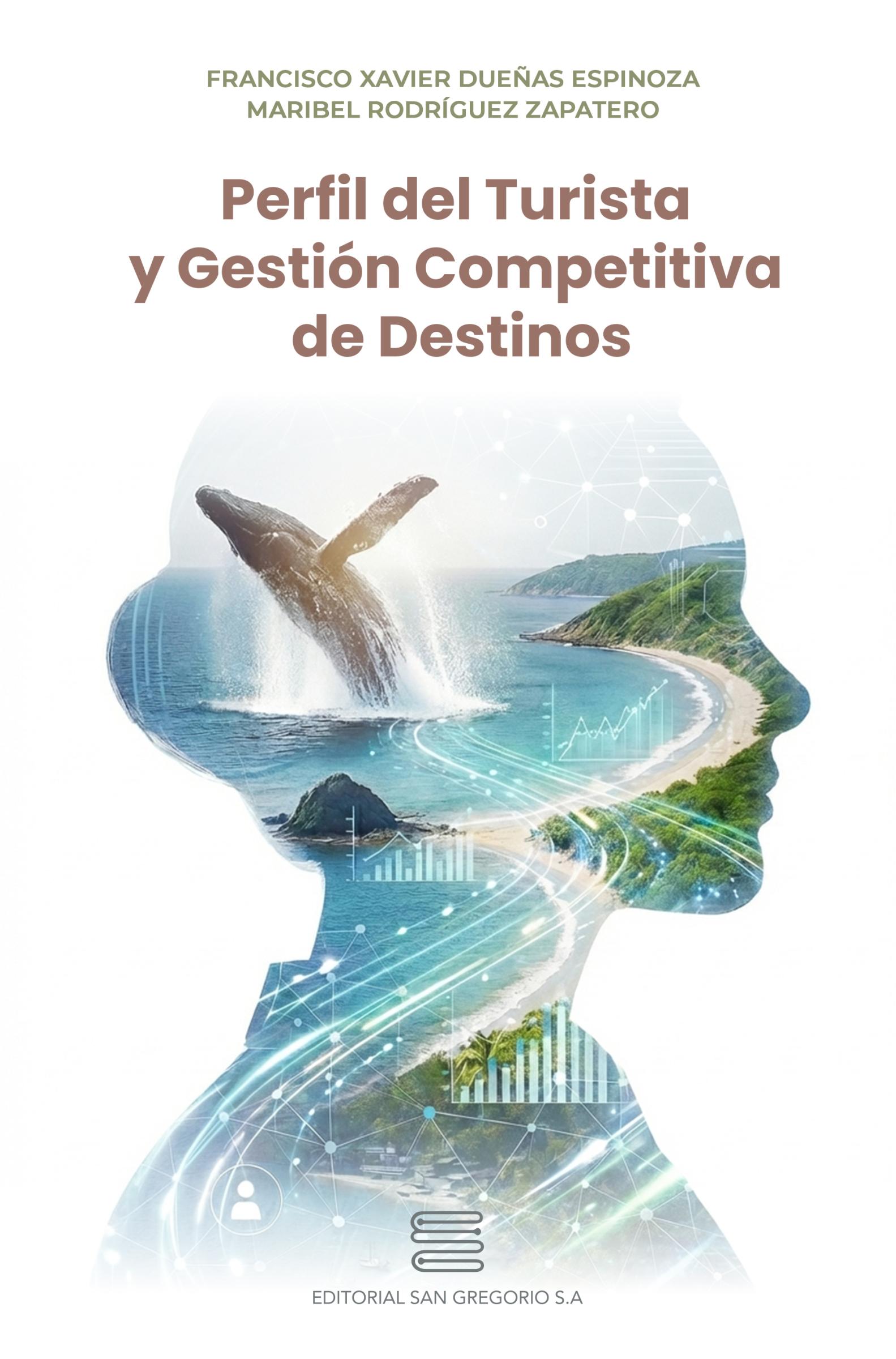
Perfil del Turista y Gestión Competitiva de Destinos es un estudio integral que analiza quiénes visitan un destino costero del Ecuador, cómo se comportan, qué actividades realizan, cuánto gastan, qué motivaciones tienen y cómo evalúan su experiencia. Mediante encuestas aplicadas a turistas y un tratamiento estadístico riguroso, la obra identifica patrones clave del visitante y los relaciona con la competitividad del destino.
El libro profundiza también en la gestión estratégica del turismo, evaluando la infraestructura, la calidad del servicio, la oferta complementaria, la gobernanza y los desafíos propios de un destino en crecimiento. Gracias a la combinación de teoría, datos reales y análisis aplicado, se convierte en una herramienta valiosa para gestores públicos, empresarios turísticos, investigadores y estudiantes que buscan comprender y mejorar la competitividad de los destinos turísticos en Ecuador.
Descargas
Los datos de descarga aún no están disponibles.
Referencias
Acerenza, M. A. (2006). Conceptualización, origen y evolución del turismo. Trillas.
Acerenza, M. A. (1993). Estudio de circuitos turísticos integrados. Estudios y Perspectivas en Turismo, 2(2). https://dialnet.unirioja.es/servlet/articulo?codigo=7399602
Acuña, A. (2004). Aproximación conceptual al fenómeno turístico en la actualidad. Gazeta de Antropología, 20, Artículo 17. http://hdl.handle.net/10481/7268
Aguiló, E., Alegre, J., & Sard, M. (2005). The persistence of the sun and sand tourism model. Tourism Management, 26(2), 219–231. https://doi.org/10.1016/j.tourman.2003.11.004
Albayrak, T., & Caber, M. (2013). The symmetric and asymmetric influences of destination attributes on overall visitor satisfaction. Current Issues in Tourism, 16(2), 149–166. https://doi.org/10.1080/13683500.2012.682978
Albayrak, T., & Caber, M. (2016). Destination attribute effects on rock climbing tourist satisfaction: An asymmetric impact-performance analysis. Tourism Geographies, 18(3), 280–296. https://doi.org/10.1080/14616688.2016.1172663
Albayrak, T., & Çömen, N. (2017). Cross-national investigation of shopping satisfaction antecedents. Journal of Vacation Marketing, 23(4), 355–364. https://doi.org/10.1177/1356766716671164
Alegre, J., & Pou, L. (2006). The length of stay in the demand for tourism. Tourism Management, 27(6), 1343–1355. https://doi.org/10.1016/j.tourman.2005.06.012
Alén, E., Nicolau, J., Losada, N., & Domínguez, T. (2014). Determinant factors of senior tourists’ length of stay. Annals of Tourism Research, 49, 19–32. https://doi.org/10.1016/j.annals.2014.08.002
Álvarez, M., & Fernández, A. (2012). Impacto económico del ocio en el siglo XXI. ARBOR, 188(754), 351–363. https://doi.org/10.3989/arbor.2012.754n2008
Amit, R., & Zott, C. (2001). Value creation in e-business. Strategic Management Journal, 22(6–7), 493–520. https://doi.org/10.1002/smj.187
Anderson, E., & Mittal, V. (2000). Strengthening the satisfaction-profit chain. Journal of Service Research, 3(2), 107–120. https://doi.org/10.1177/109467050032001
Antón, S., & González, F. (2008). A propósito del turismo: La construcción social del espacio turístico. Editorial UOC.
Arellano, R. (2010). Marketing: Enfoque América Latina. El marketing científico aplicado a Latinoamérica. Pearson Educación.
Armadans, I. (2002). Actividad de ocio-turístico y personas mayores: Análisis de diferencias psicosociales entre “viajeros” y “no viajeros” [Tesis doctoral, Universidad de Barcelona]. https://www.tdx.cat/bitstream/handle/10803/2662/TESIARMADANS.pdf
Artal, A., García, A., & Navarro, J. (2010). Factores determinantes de la duración de la estancia turística en un destino de sol y playa: El caso de la Región de Murcia. Cuadernos de Economía, 33(91), 43–66. https://doi.org/10.1016/S0210-0266(10)70057-1
Astudillo-Sánchez, E., Pérez, J., Troccoli, L., Aponte, H., & Tinoco, O. (2019). Flora leñosa del bosque de garúa de la Cordillera Chongón Colonche, Santa Elena – Ecuador. Ecología Aplicada, 18(2), 155–169. https://doi.org/10.21704/rea.v18i2.1334
Badau, D., & Badau, A. (2018). The motric, educational, recreational and satisfaction impact of adventure education activities in the urban tourism environment. Sustainability, 10(6), 2106. https://doi.org/10.3390/su10062106
Barrera, C., Barrera, C., & Bahamondes, R. (2012). Turismo sostenible: Importancia en el cuidado del medio ambiente. Revista Interamericana de Ambiente y Turismo, 8(1), 50–56. https://nucif.net/wp-content/uploads/2019/12/3-Turismo-sostenible.pdf
Bartikowski, B., & Llosa, S. (2004). Customer satisfaction measurement: Comparing four methods of attribute categorisations. The Service Industries Journal, 24(4), 67–82. https://doi.org/10.1080/0264206042000275190
Beard, J., & Ragheb, M. (1983). Measuring leisure motivation. Journal of Leisure Research, 15(3), 219–228. https://doi.org/10.1080/00222216.1983.11969557
Beni, M. C. (1990). Sistema de turismo-SISTUR: Estudo do turismo face à moderna teoria de sistemas. Turismo em Análise, 1(1), 15–34. https://www.revistas.usp.br/rta/article/viewFile/63854/66610
Bordas, E. (1994). Convertir recursos turísticos en productos turísticos. En Actas del III Simposio Internacional de Turismo. https://www.ucipfg.com/Repositorio/MGTS/MGTS14/MGTSV-06/semana2/El-consumidor-turistico/el_consumidor_turistico_%20Borja%20Sole_cap3.pdf
Boullón, R. C. (2006). Planificación del espacio turístico (4.ª ed.). Trillas.
Brandt, R. D. (1988). How service marketers can identify value-enhancing service elements. Journal of Services Marketing, 2(3), 35–41. https://doi.org/10.1108/eb024732
Bucherer, E., Eisert, U., & Gassmann, O. (2012). Towards systematic business model innovation: Lessons from product innovation management. Creativity and Innovation Management, 21(2), 183–198. https://doi.org/10.1111/j.1467-8691.2012.00637.x
Caber, M., & Albayrak, T. (2016). Push or pull? Identifying rock climbing tourists’ motivations. Tourism Management, 55, 74–84. https://doi.org/10.1016/j.tourman.2016.02.003
Caber, M., Albayrak, T., & Loiacono, E. (2012). The classification of extranet attributes in terms of their asymmetric influences on overall user satisfaction. Journal of Travel Research, 52(1), 106–116. https://doi.org/10.1177/0047287512451139
Calderón, H., Gil, I., Pons, C., & Gallarza, M. (2004). The “sun and beach” tourism destination image: An application to the case of Cuba from the Spanish market. Tourism Review, 59(1), 16–24. https://doi.org/10.1108/eb058426
Cameron, C., & Gatewood, J. (2008). Beyond sun, sand and sea: The emergent tourism programme in the Turks and Caicos Islands. Journal of Heritage Tourism, 3(1), 55–73. https://doi.org/10.1080/1743873X.2008.9701250
Campodónico, G. (2012). Relaciones entre cultura, turismo y patrimonio: Apuntes sobre las investigaciones socioculturales en Uruguay. En 5.º Congreso Latinoamericano de Investigação Turística. Universidade de São Paulo.
Cànoves, G., Prat, J. M., & Blanco, A. (2016). Turismo en España, más allá del sol y la playa. Boletín de la Asociación de Geógrafos Españoles, 71, 431–454. https://doi.org/10.21138/bage.2289
Carballo, R., Fraiz, J., Araujo, N., & Rivo, E. (2016). Segmentación del mercado de un destino turístico de interior: El caso de A Ribeira Sacra (Ourense). PASOS. Revista de Turismo y Patrimonio Cultural, 14(2), 369–383. https://www.redalyc.org/pdf/881/88145251005.pdf
Cárdenas, F. (2008). Producto turístico: Aplicación de la estadística y del muestreo para su diseño (2.ª ed.). Trillas.
Cardoso, C., Castillo, M., & Hernández, C. (2014). Sosteniendo al turismo o turismo sostenible (TS): Reflexiones teóricas. Estudios y Perspectivas en Turismo, 23(2), 376–395. https://www.redalyc.org/pdf/1807/180730867009.pdf
Carvache-Franco, M., Carvache-Franco, W., Carvache-Franco, O., Hernández-Lara, A. B., & Buele, C. V. (2019b). Segmentation, motivation, and sociodemographic aspects of tourist demand in a coastal marine destination: A case study in Manta (Ecuador). Current Issues in Tourism, 23(10), 1234–1247. https://doi.org/10.1080/13683500.2019.1600476
Carvache-Franco, M., Segarra-Oña, M., & Carrascosa-López, C. (2019a). Segmentation by motivation in ecotourism: Application to protected areas in Guayas, Ecuador. Sustainability, 11(1), 240. https://doi.org/10.3390/su11010240
Casadesus-Masanell, R., & Zhu, F. (2013). Business model innovation and competitive imitation: The case of sponsor-based business models. Strategic Management Journal, 34(4), 464–482. https://doi.org/10.1002/smj.2022
Castaño, J. M., Moreno, A., & Crego, A. (2007). Perfiles turísticos en una muestra de sujetos españoles: Un modelo de segmentación empírica en función de los patrones de viajes y las características del viajero. Estudios Turísticos, 171, 57–76. https://estudiosturisticos.tourspain.es/index.php/ET/article/download/994/993
Castillo, M. (2017). El valor de la movilidad universitaria internacional como modalidad del turismo idiomático: España y Alemania [Tesis doctoral, Universidad de Córdoba]. http://helvia.uco.es/xmlui/handle/10396/15056
Cavalcante, S., Kesting, P., & Ulhøi, J. (2011). Business model dynamics and innovation: (Re)establishing the missing linkages. Management Decision, 49(8), 1327–1342. https://doi.org/10.1108/00251741111163142
Chan, C.-S., Chiu, H., & Marafa, L. (2017). The Mainland Chinese market for nature tourism in Hong Kong. Tourism Geographies, 19(5), 801–822. https://doi.org/10.1080/14616688.2017.1360387
Chen, C. F., & Phou, S. (2013). A closer look at destination image, personality, relationship, and loyalty. Tourism Management, 36, 269–278. https://doi.org/10.1016/j.tourman.2012.11.015
Chen, C. F., & Tsai, D. C. (2007). How destination image and evaluative factors affect behavioral intentions. Tourism Management, 28(4), 1115–1122. https://doi.org/10.1016/j.tourman.2006.07.007
Chesbrough, H. (2010). Business model innovation: Opportunities and barriers. Long Range Planning, 43(2–3), 354–363. https://doi.org/10.1016/j.lrp.2009.07.010
Chesbrough, H., Lettl, C., & Ritter, T. (2018). Value creation and value capture in open innovation. Journal of Product Innovation Management, 35(6), 930–938. https://doi.org/10.1111/jpim.12471
Chi, C., & Qu, H. (2008). Examining the structural relationships of destination image, tourist satisfaction and destination loyalty: An integrated approach. Tourism Management, 29(4), 624–636. https://doi.org/10.1016/j.tourman.2007.06.007
Chicaíza, M. S., & Rivadeneira, V. H. (2019). Plan estratégico de desarrollo turístico del cantón Puerto López 2019-2023. http://repositorio.sangregorio.edu.ec/bitstream/123456789/1227/1/Plan%20Estrat%c3%a9gico%20Puerto%20L%c3%b3pez%20final.pdf
Clark, J., Konda, K., Silva, A., Peinado, J., Lama, J., Kusunoki, L., Perez-Brumer, A., Pun, M., Cabello, R., Sebastian, J. L., Suarez-Ognio, L., & Sanchez, J. (2014). Sampling methodologies for epidemiologic surveillance of men who have sex with men and transgender women in Latin America: An empiric comparison of convenience sampling, time space sampling, and respondent driven sampling. AIDS and Behavior, 18, 2338–2348. https://doi.org/10.1007/s10461-013-0680-0
Coello, F. E. (2017). Planificación territorial de espacios rurales para la utilización del turismo como herramienta para la conservación de la riqueza natural y patrimonial de estos [Tesis doctoral, Universitat de les Illes Balears]. http://hdl.handle.net/11201/148217
Cohen, E. (1984). The sociology of tourism: Approaches, issues, and findings. Annual Review of Sociology, 10(1), 373–392. https://doi.org/10.1146/annurev.so.10.080184.002105
Cohen, N., & Gómez, G. (2019). Metodología de la investigación, ¿para qué?: La producción de los datos y los diseños. CLACSO. https://doi.org/10.2307/j.ctvxcrxxz
Cohen, S. A., & Cohen, E. (2017). New directions in the sociology of tourism. Current Issues in Tourism, 22(2), 153–172. https://doi.org/10.1080/13683500.2017.1347151
Concha, R. (2017). Dinámica del turismo y transformaciones en los usos del patrimonio en la Isla de Pascua [Tesis doctoral, Universidad de Barcelona]. https://tesisenred.net/handle/10803/461150
Dagnino, J. (2014). Análisis de varianza. Revista Chilena de Anestesia, 43(4), 306–310. https://revistachilenadeanestesia.cl/analisis-de-varianza/
Dann, G. (1981). Tourist motivation: An appraisal. Annals of Tourism Research, 8(2), 187–219. https://doi.org/10.1016/0160-7383(81)90082-7
Del Risco, Y., & Mundet i Cerdan, L. (2005). El turismo como estrategia de desarrollo en Cuba. Estudios Geográficos, 66(258), 293–318. https://doi.org/10.3989/egeogr.2005.i258.163
Dueñas, X., & Rodríguez, M. (2016). Revisión bibliográfica sobre modelos de negocios en áreas turísticas protegidas: Caso específico ATP Puerto López. En P. J. Quijije & D. V. Carreño (Eds.), Memoria del Primer Congreso Internacional Innovación, Tecnología y Emprendimiento Social Post-Desastre (pp. 629–639). https://libros.uleam.edu.ec/producto/memoria-primer-congreso-internacional-innovacion-tecnologia-y-emprendimiento-social-post-desastre/
Elad, P., Yagil, Y., Cohen, L., & Meller, I. (2003). A jeep trip with young adult cancer survivors. Supportive Care in Cancer, 11(4), 201–206. https://doi.org/10.1007/s00520-002-0426-4
Erkuş-Öztürk, H., & Terhorst, P. (2017). Tourism-firm differentiation and place differentiation in the sun-sea-sand tourism city of Antalya. METU Journal of the Faculty of Architecture, 34(2), 181–202. https://doi.org/10.4305/METU.JFA.2017.2.10
Esteban, J. (2013). Turismo cultural y gestión de museos. Dykinson.
Evans, S., Vladimirova, D., Holgado, M., Van Fossen, K., Yang, M., Silva, E., & Barlow, C. (2017). Business model innovation for sustainability: Towards a unified perspective for creation of sustainable business models. Business Strategy and the Environment, 26(5), 597–608. https://doi.org/10.1002/bse.1939
Faria, D. (2012). Análisis de la capacidad del turismo en el desarrollo económico regional: El caso de Inhotim y Brumadinho [Tesis doctoral, Universidad de Alicante]. https://hdl.handle.net/1843/AMSA-8WTK9U
Fernández, J., & Fernández, A. (2018). Paisajes y turismo. UNED.
Fielt, E. (2013). Conceptualising business models: Definitions, frameworks and classifications. Journal of Business Models, 1(1), 85–105. http://journalofbusinessmodels.com/vol-1-no-1-2013/vol-1-no-1-pp-85-105/
Figuerola, M. (2004). La organización técnica y administrativa de la política económica del turismo: Especial referencia al caso español. Quaderns de Política Económica, 7, 9–34. https://www.uv.es/qpe/revista/num7/figuerola7.pdf
Flores, D., & de la O Barroso, M. (2012). La demanda turística internacional: Medio siglo de evolución. Revista de Economía Mundial, 32, 127–149. https://www.redalyc.org/pdf/866/86625395006.pdf
Forné, F. (2015). El turisme gastronòmic: Autenticitat i desenvolupament local en zones rurals. Documents d’Anàlisi Geogràfica, 61(2), 289–304. https://doi.org/10.5565/rev/dag.218
Füller, J., & Matzler, K. (2008). Customer delight and market segmentation: An application of the three-factor theory of customer satisfaction on life style groups. Tourism Management, 29(1), 116–126. https://doi.org/10.1016/j.tourman.2007.03.021
Füller, J., Matzler, K., & Faullant, R. (2006). Asymmetric effects in customer satisfaction. Annals of Tourism Research, 33(4), 1159–1163. https://doi.org/10.1016/j.annals.2006.06.006
García, C. (2013). Turismo, derechos humanos y poblaciones indígenas [Tesis doctoral, Universidad Rey Juan Carlos]. https://www.corteidh.or.cr/tablas/r38075.pdf
Garst, B., Scheider, I., & Baker, D. (2001). Outdoor adventure program participation impacts on adolescent self-perception. Journal of Experiential Education, 24(1), 41–49. https://doi.org/10.1177/105382590102400109
Gassmann, O., Frankenberger, K., & Csik, M. (2014). Revolutionizing the business model. En O. Gassmann & F. Schweitzer (Eds.), Management of the fuzzy front end of innovation (pp. 89–97). Springer. https://doi.org/10.1007/978-3-319-01056-4_7
Geissdoerfer, M., Vladimirova, D., & Evans, S. (2018). Sustainable business model innovation: A review. Journal of Cleaner Production, 198, 401–416. https://doi.org/10.1016/j.jclepro.2018.06.240
Giampiccoli, A., & Mtapuri, O. (2014). Moving beyond the 3S’s—Sun, sea, and sand: An interpretation of the tourism development strategy framework for Abu Dhabi, U.A.E. Arab World Geographer, 17(4), 339–356. http://hdl.handle.net/10321/1459
Gobierno Autónomo Descentralizado Municipal de Puerto López. (2014). Plan de desarrollo y ordenamiento territorial de Puerto López 2014–2019. https://www.puertolopez-meta.gov.co/MiMunicipio/ProgramadeGobierno/Plan%20de%20De%20Desarrollo%202016-2019.pdf
Guerrero, M. (2015). Aplicación del modelo de Kano al análisis de la satisfacción de los estudiantes en los cursos de formación online [Tesis doctoral, Universitat Politècnica de València]. https://riunet.upv.es/handle/10251/59523
Guerrero, P., & Ramos, J. R. (2014). Introducción al turismo. Grupo Editorial Patria.
Gurría, M. (1991). Introducción al turismo. Trillas.
Hall, M., & Mitchell, R. (2004). Gastronomic tourism: Comparing food and wine tourism experiences. En M. Novelli (Ed.), Niche tourism: Contemporary issues, trends and cases (pp. 73–88). Routledge.
Hernández, J., Di-Clemente, E., & López, T. (2015). El turismo gastronómico como experiencia cultural: El caso práctico de la ciudad de Cáceres (España). Boletín de la Asociación de Geógrafos Españoles, 68, 407–427. https://doi.org/10.21138/bage.1868
Hernández, R., Fernández, C., & Baptista, M. (2014). Metodología de la investigación (6.ª ed.). McGraw-Hill.
Ibáñez, R. M., & Cabrera, C. (2011). Teoría general del turismo: Un enfoque global y nacional. Academia de Investigación Turística.
ICOMOS. (1999). Carta internacional sobre turismo cultural: La gestión del turismo en los sitios con patrimonio significativo. https://icomos.es/wp-content/uploads/2020/01/tourism_sp.pdf
Iso-Ahola, S. (1982). Toward a social psychological theory of tourism motivation: A rejoinder. Annals of Tourism Research, 9(2), 256–262. https://doi.org/10.1016/0160-7383(82)90049-4
Jacobsen, J., Gössling, S., Dybedal, P., & Skogheim, T. (2018). Exploring length of stay: International tourism in south-western Norway. Journal of Hospitality and Tourism Management, 35, 29–35. https://doi.org/10.1016/j.jhtm.2018.02.003
Jafari, J. (1994). La cientifización del turismo. Estudios y Perspectivas en Turismo, 3(1). http://www.eumed.net/ce/2005/jafari.htm
Jafari, J. (2000). Encyclopedia of tourism. Routledge. https://doi.org/10.4324/9780203195673
Jelinčić, D. A., & Senkić, M. (2017). Creating a heritage tourism experience: The power of the senses. Etnološka Tribina, 47(40), 109–126. https://hrcak.srce.hr/file/281992
Jeong, Y., Zielinski, S., Chang, J.-S., & Kim, S.-I. (2018). Comparing motivation-based and motivation-attitude-based segmentation of tourists visiting sensitive destinations. Sustainability, 10(10), 3615. https://doi.org/10.3390/su10103615
Jiménez, A. J. (2005). Una aproximación a la conceptualización del turismo desde la teoría general de sistemas (8.ª ed.). Editorial Miguel Ángel Porrúa.
Jiménez, A. J., Ortiz, D. D., Velarde, M., & Bergeret, R. J. (2017). Guía introductoria a la dimensión temática del sistema turístico. UAGro.
Johnston, R. (1995). The determinants of service quality: Satisfiers and dissatisfiers. International Journal of Service Industry Management, 6(5), 53–71. https://doi.org/10.1108/09564239510101536
Juliao, D. (2014). Segmentación, mercado meta y posicionamiento. En M. Ortiz (Ed.), Marketing: Conceptos y aplicaciones (pp. 127–152). Universidad del Norte Editorial.
Kaihara, T., Nishino, N., Ueda, K., Tseng, M., Váncza, J., Schönsleben, P., Teti, R., & Takenaka, T. (2018). Value creation in production: Reconsideration from interdisciplinary approaches. CIRP Annals, 67(2), 791–814. https://doi.org/10.1016/j.cirp.2018.05.002
Kano, N., Seraku, N., Takahashi, F., & Tsuji, S. (1984). Attractive quality and ordinary quality. Journal of the Japanese Society for Quality Control, 14(2), 147–156. https://doi.org/10.20684/quality.14.2_147
Kim, S., Lee, C.-K., & Klenosky, D. (2003). The influence of push and pull factors at Korean national parks. Tourism Management, 24(2), 169–180. https://doi.org/10.1016/S0261-5177(02)00059-6
Knowles, N. L. B. (2019). Targeting sustainable outcomes with adventure tourism: A political ecology approach. Annals of Tourism Research, 79, Article 102809. https://doi.org/10.1016/j.annals.2019.102809
Ko, E., Kim, E., Taylor, C., Hoom, K., & Jeong, K. (2007). Cross-national market segmentation in the fashion industry: A study of European, Korean, and US consumers. International Marketing Review, 24(5), 629–651. https://doi.org/10.1108/02651330710828022
Korstanje, M. E. (2013). Epistemología del turismo: Teoría del sistema onírico. Palermo Business Review, 10, 11–24. https://www.palermo.edu/economicas/cbrs/pdf/reee10/BR10_01.pdf
Korstanje, M. E. (2014). Teoría turística: Del choque cultural a la percepción del riesgo. TURYDES: Turismo y Desarrollo Local Sostenible, 7(16). https://revistaturydes.com/index.php/turydes/article/view/1320
Kotler, P., García de Madariaga, J., Flores, J., Bowen, J. T., & Makens, J. C. (2011). Marketing turístico (5.ª ed.). Pearson Educación.
Krapf, K. (1953). La consumición turística: Una contribución a la teoría de la consumición (F. Muñoz de Escalona, Trad.). Eumed.
Lacosta, A. J. (2004). La configuración de nuevos destinos turísticos de interior en España a partir del turismo activo y de aventura (1992–2001). Cuadernos Geográficos, 34, 11–31. https://www.redalyc.org/pdf/171/17103402.pdf
Leal, M. P., & López, F. (2017). La dimensión territorial del turismo gastronómico en Cataluña (España): Una interpretación a partir de la geografía económica relacional. Boletín de la Asociación de Geógrafos Españoles, 74, 93–116. https://doi.org/10.21138/bage.2446
Leiper, N. (1979). The framework of tourism: Toward a definition of tourism, tourist, and the tourist industry. Annals of Tourism Research, 6(4), 390–407. https://doi.org/10.1016/0160-7383(79)90003-3
Leung, K., Bhagat, R., Buchan, N., Erez, M., & Gibson, C. (2005). Culture and international business: Recent advances and their implications for future research. Journal of International Business Studies, 36(4), 357–378. https://doi.org/10.1057/palgrave.jibs.8400150
Lew, A., & McKercher, B. (2006). Modeling tourist movements: A local destination analysis. Annals of Tourism Research, 33(2), 403–423. https://doi.org/10.1016/j.annals.2005.12.002
Li, X., Cheng, C., Kim, H., & Petrick, J. F. (2008). A systematic comparison of first-time and repeat visitors via a two-phase online survey. Tourism Management, 29(2), 278–293. https://doi.org/10.1016/j.tourman.2007.03.010
Lin, C. H., Morais, D. B., Kerstetter, D. L., & Hou, J. S. (2007). Examining the role of cognitive and affective image in predicting choice across natural, developed, and theme-park destinations. Journal of Travel Research, 46(2), 183–194. https://doi.org/10.1177/0047287506304049
López-Dóriga, U., Jiménez, J., Valdemoro, H., & Nicholls, R. (2019). Impact of sea-level rise on the tourist-carrying capacity of Catalan beaches. Ocean & Coastal Management, 170, 40–50. https://doi.org/10.1016/j.ocecoaman.2018.12.028
Machado, E. L. (2013). Integración y diseño del producto turístico aplicado a la región central del destino Cuba. GeoGraphos, 4(35), 69–92. http://rua.ua.es/dspace/handle/10045/25769
Magaš, D., Debelić, B., & Vilke, S. (2018). Users’ perception as a tool for an integrated coastal management and beach quality assessment. Pomorstvo, 32(2), 290–296. https://doi.org/10.31217/p.31.2.14
Makua, A., Eizaguirre, A., & Molina, A. (2013). The living industry visit in Euskadi: Analysis and description of the current profile of “living industry tourist.” ROTUR. Revista de Ocio y Turismo, 6(1), 106–121. https://ruc.udc.es/bitstreams/68449360-c38d-450e-939e-2b08b83a77f4/download
Martínez, E. (2008). Tipos de tiempo para el turismo de sol y playa en el litoral alicantino. Estudios Geográficos, 69(264), 135–155. https://doi.org/10.3989/egeogr.2008.i264.82
Martínez, V. (2017). El turismo de naturaleza: Un producto turístico sostenible. ARBOR, 193(785), a396. https://doi.org/10.3989/arbor.2017.785n3002
Maslow, A. H. (1991). Motivación y personalidad. Ediciones Díaz de Santos.
Matas, A. (2018). Diseño del formato de escalas tipo Likert: Un estado de la cuestión. Revista Electrónica de Investigación Educativa, 20(1), 38–47. https://doi.org/10.24320/redie.2018.20.1.1347
Matilainen, A., & Lähdesmäki, M. (2014). Nature-based tourism in private forests: Stakeholder management balancing the interests of entrepreneurs and forest owners? Journal of Rural Studies, 35, 70–79. https://doi.org/10.1016/j.jrurstud.2014.04.007
Matzler, K., & Renzl, B. (2007). Assessing asymmetric effects in the formation of employee satisfaction. Tourism Management, 28(4), 1093–1103. https://doi.org/10.1016/j.tourman.2006.07.009
Matzler, K., & Sauerwein, E. (2002). The factor structure of customer satisfaction: An empirical test of the importance grid and the penalty-reward-contrast analysis. International Journal of Service Industry Management, 13(4), 314–332. https://doi.org/10.1108/09564230210445078
Matzler, K., Renzl, B., & Rothenberger, S. (2006). Measuring the relative importance of service dimensions in the formation of price satisfaction and service satisfaction: A case study in the hotel industry. Scandinavian Journal of Hospitality and Tourism, 6(3), 179–196. https://doi.org/10.1080/15022250600872850
McKercher, B., & Wong, D. (2004). Understanding tourism behavior: Examining the combined effects of prior visitation history and destination status. Journal of Travel Research, 43(2), 171–179. https://doi.org/10.1177/0047287504268246
Medina, D., & Medina, R. (2012). Determinants of expenditures on wellness services: The case of Gran Canaria. Regional Studies, 46(3), 309–319. https://doi.org/10.1080/00343404.2010.510501
Medlik, S., & Middleton, V. T. (1973). The product formulation in tourism. Tourism and Marketing, 13. AIEST.
Melo, A., & Cardozo, P. F. (2015). Patrimônio, turismo cultural e educação patrimonial. Educação & Sociedade, 36(133), 1059–1075. https://doi.org/10.1590/ES0101-73302015137387
Mendoza-González, G., Martínez, M. L., Guevara, R., Pérez-Maqueo, O., Garza-Lagler, M. C., & Howard, A. (2018). Towards a sustainable sun, sea, and sand tourism: The value of ocean view and proximity to the coast. Sustainability, 10(4), 1012. https://doi.org/10.3390/su10041012
Meng, F., Tepanon, Y., & Uysal, M. (2008). Measuring tourist satisfaction by attribute and motivation: The case of a nature-based resort. Journal of Vacation Marketing, 14(1), 41–56. https://doi.org/10.1177/1356766707084218
Merinero, R., & Zamora, E. (2009). La colaboración entre los actores turísticos en ciudades patrimoniales: Reflexiones para el análisis del desarrollo turístico. PASOS. Revista de Turismo y Patrimonio Cultural, 7(2), 219–238. https://www.redalyc.org/articulo.oa?id=88111635006
Middleton, V. C., Fyall, A., Morgan, M., & Ranchhold, A. (2009). Marketing in travel and tourism (4th ed.). Elsevier.
Mikulić, J., & Prebežac, D. (2008). Prioritizing improvement of service attributes using impact range-performance analysis and impact-asymmetry analysis. Managing Service Quality: An International Journal, 18(6), 559–576. https://doi.org/10.1108/09604520810920068
Mikulić, J., & Prebežac, D. (2011). A critical review of techniques for classifying quality attributes in the Kano model. Managing Service Quality: An International Journal, 21(1), 46–66. https://doi.org/10.1108/09604521111100243
Milio, I. (2004). Diseño y comercialización de productos turísticos locales y regionales. Ediciones Paraninfo.
Millán, G., Morales, E., & Pérez, L. M. (2014). Turismo gastronómico, denominaciones de origen y desarrollo rural en Andalucía: Situación actual. Boletín de la Asociación de Geógrafos Españoles, 65. https://doi.org/10.21138/bage.1746
Milovanovic, B., Srhoj, S., & Kristo, T. (2016). Business models as a conceptual framework for designing business of contemporary firms. Ekonomska Misao i Praksa, 25(2), 535–563. https://hrcak.srce.hr/171476
Ministerio de Turismo. (2014). Diseño del plan estratégico de desarrollo de turismo sostenible para Ecuador: PLANDETUR 2020. https://guachapala.gob.ec/wp-content/uploads/2014/09/Plan-Estrategico-de-desarrollo.pdf
Mittal, V., Ross, W. T., & Baldasare, P. M. (1998). The asymmetric impact of negative and positive attribute-level performance on overall satisfaction and repurchase intentions. Journal of Marketing, 62(1), 33–47. https://doi.org/10.1177/002224299806200104
Molina, S., & Rodríguez, S. (1991). Planificación integral del turismo: Un enfoque para Latinoamérica (2.ª ed.). Trillas.
Montenegro-Pazmiño, E. C., Delgado, B., & León, J. (2020). Educación ambiental en el proyecto de reintroducción del guacamayo verde mayor (Ara ambiguus) en Ecuador. Letras Verdes: Revista Latinoamericana de Estudios Socioambientales, 28, 144–162. https://doi.org/10.17141/letrasverdes.28.2020.4321
Monterrubio, J. C. (2012). Turismo y cambio sociocultural: Una perspectiva conceptual. Plaza y Valdés Editores.
Moral, S. (2017). Turismo y desarrollo sostenible en la frontera norte dominico-haitiana: Descripción de la oferta y análisis de la demanda [Tesis doctoral, Universidad de Córdoba]. https://helvia.uco.es/bitstream/handle/10396/14916/2017000001623.pdf
Morillo, M. C. (2011). Turismo y producto turístico: Evolución, conceptos, componentes y clasificación. Visión Gerencial, 1, 135–158. https://www.redalyc.org/articulo.oa?id=465545890011
McFarlane-Morris, S. (2011). Beyond sun, sea and sand: The rhythm of music tourism in Kingston, Jamaica. Caribbean Geography, 16(1), 76–88.
Ogilvie, F. W. (1936). The tourist industry: A national and international survey. The Economic Journal, 46(184), 732–734. https://doi.org/10.2307/2224701
Novo, G. (1997). Diccionario general de turismo. Editorial Diana.
Oliva, M., & Lonardi, P. (2017). Metodología de la investigación social aplicada al turismo. Ugerman Editor.
Oliveira, S. (2011). La gastronomía como atractivo turístico primario de un destino: El turismo gastronómico en Mealhada, Portugal. Estudios y Perspectivas en Turismo, 20(3), 738–752. https://www.redalyc.org/articulo.oa?id=180717583012
Oliver, R. L. (1980). A cognitive model of the antecedents and consequences of satisfaction decisions. Journal of Marketing Research, 17(4), 460–469. https://doi.org/10.2307/3150499
Organización Mundial del Turismo. (2016). Compilación de recomendaciones de la OMT 1975–2015. https://frrq.cvg.utn.edu.ar/pluginfile.php/16459/mod_resource/content/0/Compilaci%C3%B3n%20de%20recomendaciones%20de%20la%20OMT.pdf
Osorio, M., Monge, L., Serrano, R., & Cortés, I. (2017). Perfil del visitante de naturaleza en Latinoamérica: Prácticas, motivaciones e imaginarios. Estudio comparativo entre México y Ecuador. PASOS. Revista de Turismo y Patrimonio Cultural, 15(3), 713–729. https://doi.org/10.25145/j.pasos.2017.15.047
Osterwalder, A., & Pigneur, Y. (2010). Business model generation: A handbook for visionaries, game changers, and challengers. Wiley.
Pastor, S. (2017). Todos los viajes el viaje: Teoría y práctica de la literatura en movimiento de Jorge Carrión. 452ºF. Revista de Teoría de la Literatura y Literatura Comparada, 16, 139–153. https://revistes.ub.edu/index.php/452f/article/view/16318
Payne, A., Frow, P., & Eggert, A. (2017). The customer value proposition: Evolution, development, and application in marketing. Journal of the Academy of Marketing Science, 45, 467–489. https://doi.org/10.1007/s11747-017-0523-z
Payne, A., Frow, P., Steinhoff, L., & Eggert, A. (2020). Toward a comprehensive framework of value proposition development: From strategy to implementation. Industrial Marketing Management, 87, 244–255. https://doi.org/10.1016/j.indmarman.2020.02.015
Pearce, P. (1988). The Ulysses factor: Evaluating visitors in tourism settings. Springer-Verlag.
Pérez, A., & Carballo, E. (2007). La gestión del conocimiento: Valor agregado del producto turístico. Contribuciones a la Economía. http://www.eumed.net/ce/
Pérez, M., García, M., Gómez, G., & Del Río, L. (2019). Segmentation based on the gastronomic motivations of tourists: The case of the Costa del Sol (Spain). Sustainability, 11(2), 409. https://doi.org/10.3390/su11020409
Peric, M., & Djurkin, J. (2014). Systems thinking and alternative business model for responsible tourist destination. Kybernetes, 43(3–4), 480–496. https://doi.org/10.1108/K-07-2013-0132
Pestana, C., & Pinto, L. (2010). The length of stay in tourism. Annals of Tourism Research, 37(3), 692–706. https://doi.org/10.1016/j.annals.2009.12.005
Piédrola, I. (2016). El turismo idiomático en Córdoba: Una oportunidad de diversificar un sector estratégico en la ciudad [Tesis doctoral, Universidad de Córdoba]. https://dialnet.unirioja.es/servlet/tesis?codigo=65154
PLANDETUR. (2020). Plan estratégico de desarrollo de turismo sostenible para Ecuador: PLANDETUR 2020. https://guachapala.gob.ec/wp-content/uploads/2014/09/Plan-Estrategico-de-desarrollo.pdf
Plog, S. C. (1974). Why destination areas rise and fall in popularity. Cornell Hotel and Restaurant Administration Quarterly, 14(4), 55–58. https://doi.org/10.1177/001088047401400409
Polizzotto, L., & Molella, A. (2019). The value balance. IEEE Engineering Management Review, 47(4), 24–31. https://doi.org/10.1109/EMR.2019.2932321
Pons, R. C. (2000). La imagen del destino y el comportamiento de compra del turista. Teoría y Praxis, 3, 89–102. https://doi.org/10.22403/UQROOMX/TYP03/07
Porcal, M. (2006). Turismo cultural, turismo religioso y peregrinación en Navarra: Las Javieradas como caso de estudio. Cuadernos de Turismo, 18, 103–134. http://www.scielo.org.mx/scielo.php?script=sci_arttext&pid=S0188-46112012000300008
Prat, J., & Cànoves, G. (2012). El turismo cultural como oferta complementaria en los destinos de litoral: El caso de la Costa Brava (España). Investigaciones Geográficas, 79, 119–135.
Presidencia de la República del Ecuador. (2013, 16 de junio). Decreto Ejecutivo 1521 (Registro Oficial Suplemento 37). https://www.registroficial.gob.ec/index.php/registro-oficial-web/publicaciones/suplementos/item/2670-suplemento-al-registro-oficial-no-37
Quan, S., & Wang, N. (2004). Towards a structural model of the tourist experience: An illustration from food experiences in tourism. Tourism Management, 25(3), 297–305. https://doi.org/10.1016/S0261-5177(03)00130-4
Reinhold, S., Zach, F., & Krizaj, D. (2017). Business models in tourism: A review and research agenda. Tourism Review, 72(4), 462–482. https://doi.org/10.1108/TR-05-2017-0094
Reinhold, S., Zach, F., & Krizaj, D. (2019). Business models in tourism – State of the art. Tourism Review, 74(6), 1120–1134. https://doi.org/10.1108/TR-02-2018-0027
Rivas, J. (2015). Estructura y economía en el mercado turístico. Septem Ediciones.
Rivera, M. (2012). Un turismo desigual en un mundo globalizado: Lógicas dominantes y alternativas de las nuevas formas de turismo responsable. En M. Rivera & L. Rodríguez (Coords.), Turismo responsable, sostenibilidad y desarrollo local comunitario (pp. 15–42). https://dialnet.unirioja.es/servlet/articulo?codigo=4335304
Rodríguez, J., Vieira, Á., & López-Guzmán, T. (2012). Segmentación del perfil de enoturista en la ruta del vino del Marco de Jerez-Xérès-Sherry. TURYDES: Revista sobre Turismo y Desarrollo Local Sostenible, 5(13), 1–14. https://www.revistaturydes.com/index.php/turydes/article/view/946
Rodríguez, M. (2020). En busca del sweet-spot en el turista arqueológico. En A. Ruiz, S. Medina, & L. M. Pérez (Eds.), Educación y divulgación del patrimonio arqueológico: La socialización del pasado como reto para el futuro (pp. 141–152). Editorial Comares.
Rudan, E., & Krstinić, M. (2018). The role of beaches in the tourism offering: The case study of the municipality of Lovran. Pomorstvo, 32(2), 219–227. https://doi.org/10.31217/p.32.2.7
Ryan, C. (1998). The travel career ladder: An appraisal. Annals of Tourism Research, 25(4), 936–957. https://doi.org/10.1016/S0160-7383(98)00044-9
Sahebalzamani, S., & Bertella, G. (2018). Business models and sustainability in nature tourism: A systematic review of the literature. Sustainability, 10(9), 3226. https://doi.org/10.3390/su10093226
Salinas, E. (2003). Geografía y turismo: Aspectos territoriales del manejo y gestión del turismo. Editorial Universitaria Félix Varela.
Sánchez, J., & Cebrián, F. (2015). Turismo de naturaleza en áreas protegidas de México: Una propuesta de conservación, aprovechamiento y desarrollo local en el Nevado de Toluca. Cuadernos de Turismo, 36, 339–365. https://doi.org/10.6018/turismo.36.231041
Santos-Lacueva, R., Anton, S., & Saladié, Ó. (2017). Discontinuidades y limitaciones de los últimos planes turísticos de España en relación a la sostenibilidad ambiental del turismo de sol y playa. Cuadernos de Turismo, 40, 599–626. https://doi.org/10.6018/turismo.40.310121
Scherrer, P., Alonso, A., & Sheridan, L. (2009). Expanding the destination image: Wine tourism in the Canary Islands. International Journal of Tourism Research, 11(5), 451–463. https://doi.org/10.1002/jtr.713
Schulte, S. (2003). Guía conceptual y metodológica para el desarrollo y la planificación del sector turismo. CEPAL. https://eco.mdp.edu.ar/cendocu/repositorio/00168.pdf
Serra, A. (2003). Marketing turístico. Ediciones Pirámide.
Serrano-Macías, M. I., & Álvarez-Gálvez, J. (2017). Educación y turismo cultural en España: Identificación de perfiles turísticos mediante la aplicación de árboles de decisión. Empiria. Revista de Metodología de Ciencias Sociales, 38, 127–150. https://doi.org/10.5944/empiria.38.2018.19714
Sessa, A. (1988). The science of systems for tourism development. Annals of Tourism Research, 15(2), 219–235. https://doi.org/10.1177/004728758902700360
Shakeel, J., Mardani, A., Chofreh, A., Goni, F., & Klemeš, J. (2020). Anatomy of sustainable business model innovation. Journal of Cleaner Production, 261, Article 121201. https://doi.org/10.1016/j.jclepro.2020.121201
Sharpe, E. (2005). Going above and beyond: The emotional labor of adventure guides. Journal of Leisure Research, 37(1), 29–50. https://doi.org/10.1080/00222216.2005.11950039
Sharpley, R. (2000). Tourism and sustainable development: Exploring the theoretical divide. Journal of Sustainable Tourism, 8(1), 1–19. https://doi.org/10.1080/09669580008667346
Shoval, N., & Birenboim, A. (2019). Customization and augmentation of experiences through mobile technologies: A paradigm shift in the analysis of destination competitiveness. Tourism Economics, 25(5), 661–669. https://doi.org/10.1177/1354816618806428
da Silva, D. S., Mendes-Filho, L., & Correa, C. (2017). Comentários de viagem na internet: Factores que influenciam a intenção de escolha de um destino de viagem. PASOS. Revista de Turismo y Patrimonio Cultural, 15(1), 229–244. https://www.redalyc.org/pdf/881/88149387014.pdf
Sjödin, D., Parida, V., Jovanovic, M., & Visnjic, I. (2020). Value creation and value capture alignment in business model innovation: A process view on outcome-based business models. Journal of Product Innovation Management, 37(2), 158–183. https://doi.org/10.1111/jpim.12516
Spieth, P., Lundberg, H., & Matzler, K. (2014). Business model innovation from an entrepreneurial perspective. International Journal of Entrepreneurship and Innovation Management, 18(4), 261–265. https://hdl.handle.net/10863/8676
Stanton, W., Etzel, M., & Walker, B. (2007). Fundamentos de marketing (14.ª ed.). McGraw-Hill Interamericana.
Sung, H. (2004). Classification of adventure travelers: Behavior, decision making, and target markets. Journal of Travel Research, 42(4), 343–356. https://doi.org/10.1177/0047287504263028
Sung, H., Morrison, A., & O’Leary, J. (1997). Definition of adventure travel: Conceptual framework for empirical application from the providers’ perspective. Asia Pacific Journal of Tourism Research, 1(2), 47–67. https://doi.org/10.1080/10941669708721975
Sutherland, S., & Stroot, S. (2010). The impact of participation in an inclusive adventure education trip on group dynamics. Journal of Leisure Research, 42(1), 153–176. https://doi.org/10.1080/00222216.2010.11950199
Teece, D. J. (2010). Business models, business strategy and innovation. Long Range Planning, 43(2–3), 172–194. https://doi.org/10.1016/j.lrp.2009.07.003
Ting, S., & Chen, C. (2002). The asymmetrical and non-linear effects of store quality attributes on customer satisfaction. Total Quality Management, 13(4), 547–569. https://doi.org/10.1080/09544120220149331
Torres, E. J. (2006). El sistema de actividades turísticas. En E. J. Torres (Coord.), Estructura de mercados turísticos (pp. 15–75). https://dialnet.unirioja.es/institucion/419/editor
Torres, F., González, L., Díaz, B., Torregroza, A., & Cantero, R. (2018). Effects of beach tourists on bathing water and sand quality at Puerto Velero, Colombia. Environment, Development and Sustainability, 20(1), 255–269. https://doi.org/10.1007/s10668-016-9880-x
Torres, P., & Molina, G. (2019). Evaluation of crowding and tourist satisfaction in the practice of humpback whale-watching: The case of Puerto López, Ecuador. Cuadernos de Gestión, 19(2), 185–207. https://doi.org/10.5295/cdg.180895pt
Tortosa, L., & Vicent, J. (2012). Geometría moderna para ingeniería. Editorial Club Universitario.
Vallejo, R., Lindoso-Tato, E., & Vilar-Rodríguez, M. (2018). Los orígenes históricos del turista y del turismo en España: La demanda turística en el siglo XIX. Investigaciones de Historia Económica, 16(1), 12–22. https://doi.org/10.1016/j.ihe.2018.03.001
Valls, J. F. (2004). Impacto del low cost en los precios hoteleros españoles. Papers de Turisme, 81–88.
Valls, J.-F., Rucabado, J., Sardá, R., & Parera, A. (2017). The beach as a strategic element of governance for Spanish coastal towns. Journal of Sustainable Tourism, 25(9), 1338–1352. https://doi.org/10.1080/09669582.2016.1273358
Velasco, V. M., Martínez, V. A., Roiz, J., Huazano, F., & Nieves, A. (2003). Muestreo y tamaño de la muestra: Una guía práctica para personal de salud que realiza investigación (V. M. Velasco, Ed.). El Cid Editor.
Weaver, D., & Lawton, L. (2011). Visitor loyalty at a private South Carolina protected area. Journal of Travel Research, 50(3), 335–346. https://doi.org/10.1177/0047287510362920
Weking, J., Hein, A., Böhm, M., & Krcmar, H. (2018). A hierarchical taxonomy of business model patterns. Electronic Markets, 30, 447–468. https://doi.org/10.1007/s12525-018-0322-5
Wong, I., McKercher, B., & Li, X. (2016). East meets West: Tourist interest in hybrid culture at postcolonial destinations. Journal of Travel Research, 55(5), 628–642. https://doi.org/10.1177/0047287514563984
Wu, X., Cao, J., & Huting, J. (2018). Using three-factor theory to identify improvement priorities for express and local bus services: An application of regression with dummy variables in the Twin Cities. Transportation Research Part A: Policy and Practice, 113, 184–196. https://doi.org/10.1016/j.tra.2018.04.003
Yi, Y., Wang, Y., & Shu, C. (2020). Business model innovations in China: A focus on value propositions. Business Horizons, 63(6), 787–799. https://doi.org/10.1016/j.bushor.2020.07.002
Yoon, Y., & Uysal, M. (2005). An examination of the effects of motivation and satisfaction on destination loyalty: A structural model. Tourism Management, 26(1), 45–56. https://doi.org/10.1016/j.tourman.2003.08.016
Yuan, J., Deng, J., Pierskalla, C., & King, B. (2018). Urban tourism attributes and overall satisfaction: An asymmetric impact-performance analysis. Urban Forestry & Urban Greening, 30, 169–181. https://doi.org/10.1016/j.ufug.2018.02.006
Yuan, Y., Tseng, Y.-H., & Ho, C.-I. (2019). Tourism information technology research trends: 1990–2016. Tourism Review, 74(1), 5–19. https://doi.org/10.1108/TR-08-2017-0128
Žabkar, V., Makovec, M., & Dmitrović, T. (2010). Modelling perceived quality, visitor satisfaction and behavioural intentions at the destination level. Tourism Management, 31(4), 537–546. https://doi.org/10.1016/j.tourman.2009.06.005
Descargas
Publicado
diciembre 11, 2025
Derechos de autor 2025 Francisco Xavier Dueñas Espinoza
Detalles sobre esta monografía
ISBN-13 (15)
978-9942-795-53-3
Cómo citar
Dueñas Espinoza, F. X., & Rodríguez Zapatero, M. (Eds.). (2025). Perfil del turista y gestión competitiva de destinos. Editorial San Gregorio. https://doi.org/10.5281/zenodo.21283234